Designing a scalable category page template to unlock 19M+ products
With no brief and no existing template to build from, I led the design of the first category page system from discovery to final implementation that could scale across 19 product families and up to 54 subcategories.
Role
Product Designer
Timeline
3 Months
Team
1 Product Owner
2 Engineers

Context
19M+ products. 19 product families. No category pages.
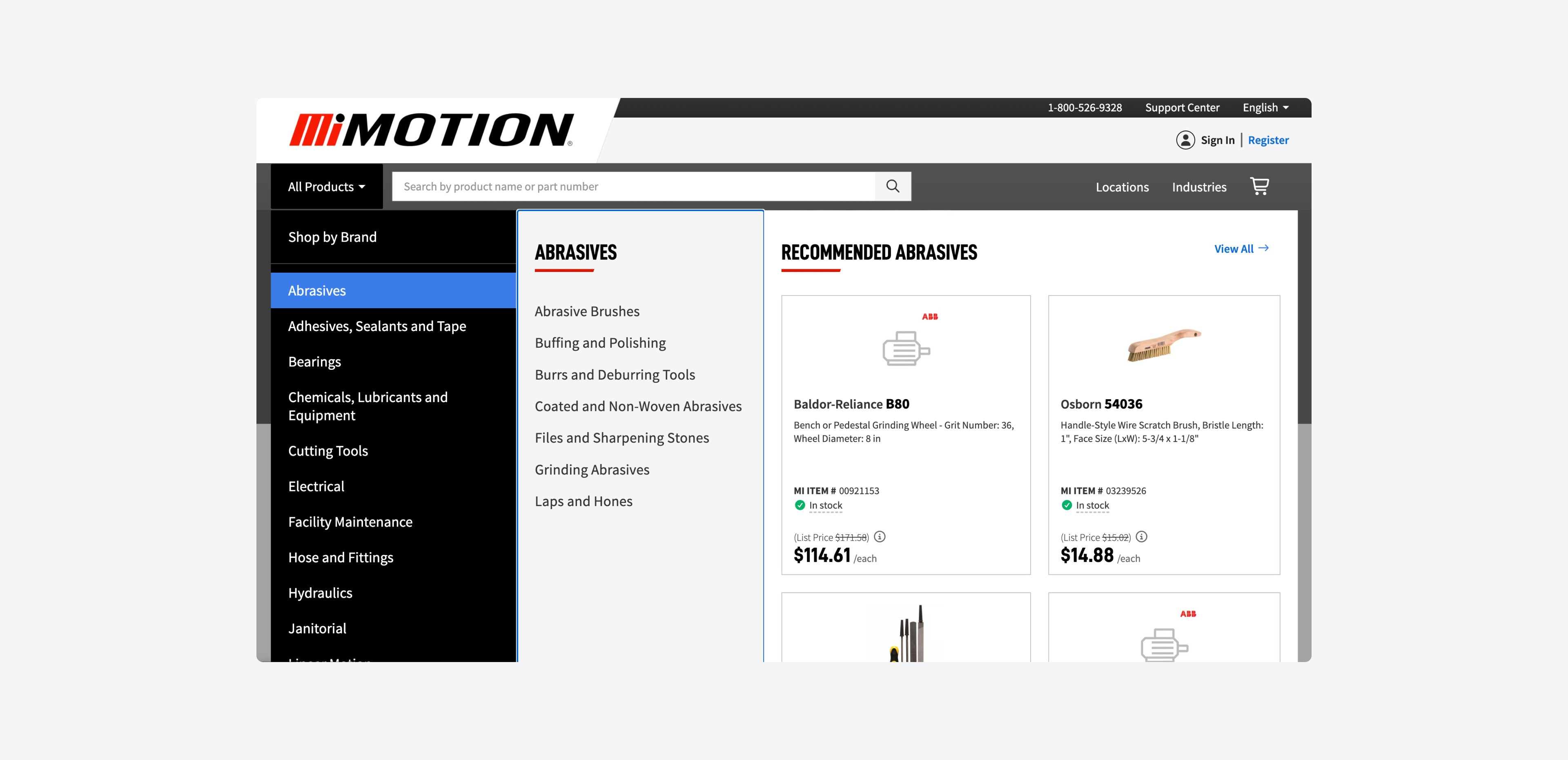
Motion Industries is North America's largest distributor of bearings and maintenance, repair and operation (MRO) products. A Baymard Institute UX audit benchmarked the site against industry leaders and flagged navigation as a key gap — category labels existed in the site nav, but were static and non-clickable, functioning as labels rather than real navigation.
Problem
If a customer didn't know the product name or part number, it was hard to find the right product.
Customers had limited guidance for figuring out where to start. That meant lost purchases. Not because the product wasn't there, but because they couldn't find it.

Challenge
Design a scalable, responsive template to adapt across 19 product families
I was responsible for figuring out what a category page should contain, how it should be structured, and how the design could scale across different product families.
Constraints
Taxonomy is fixed
No changes or edits
19 product families
with different structures
Up to 54 categories
within a product family
Design Decision
Establishing one consistent page structure
I defined the core content and hierarchy to be shared across all product families. Each section provides different pathways to help customers move forward along the customer journey.

Design Decision
Make technical categories easy to scan
Customers were often navigating unfamiliar technical products, so I explored how imagery, hierarchy, and content density could help them quickly understand their options and choose where to go next.

Design Decision
Building a dynamic framework that scales
I defined rules for small, medium and large product families so the system could accomodate different levels of complexity. This would standardize the core experience while allowing the number and type of categories to change by product family.

Outcomes
From one page to a scalable system
19 category pages
live and shipped
54
subcategories supported
1
scalable system
